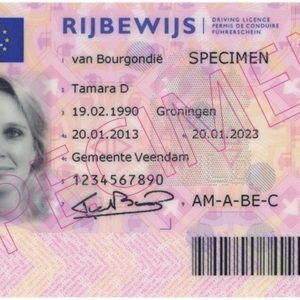
Dutch Driver’s License
In the Netherlands, a licence to drive a car (licence B) can be obtained from the age of 17. However, the drivers must be supervised by an adult, who’s at least 27 years old, until reaching the age of 18. If two serious offenses are committed within five years of a licence being issued to a new driver, the holder will have their licence revoked and must pass the test again to get their licence back.
Buy Dutch Driver’s License Online
In the Netherlands, a licence to drive a car (licence B) can be obtained from the age of 17. However, the drivers must be supervised by an adult, who’s at least 27 years old, until reaching the age of 18. If two serious offenses are committed within five years of a licence being issued to a new driver, the holder will have their licence revoked and must pass the test again to get their licence back.
The offences include:
Tailgating
Exceeding the speed limit by at least 30 km/h (19 mph)
Drunk driving (blood alcohol content of 0.2 per mille or above)
Causing death or injury by dangerous driving
A moped can be driven by persons aged 16 or over who are in possession of a moped licence (category AM). Since March 1, 2010 every driver is required to pass a practical exam in addition to a theory exam. Holders of category A or B licences are allowed to drive a moped without any additional documents or testing.
From 1 July 2015, a driving licence is required for a tractor designated with T. This licence can be obtained from 16 years of age. People with a driver’s licence for cars (B) obtained on or before July 1, 2015 can drive a tractor without additional exams.
How to get a Dutch Driver’s License
There are a few steps one needs to follow to obtain a licence. One has to go to a driving school (rijschool) and start to learn how to drive. There is also a compulsory theory exam at the CBR (Centraal Bureau Rijvaardigheidsbewijzen). In the Netherlands, bicycles are a very important part of the test. Cyclists are everywhere and cars need to yield to them quite frequently. Not yielding to a cyclist during your exam means you have failed automatically. One can also take the test in an automatic vehicle, which means one is only allowed to drive an automatic vehicle (code 78). There is no legal minimum number of lessons to be taken.
When the learner has passed their theory exam, they can request a TTT (TussenTijdse Toets). This is an intermediate exam in which the learner needs to do two special manoeuvres. If they complete these successfully, they are exempted from those manoeuvres in the final practical test. The manoeuvres include:
Parking
Stopping (stopopdracht), i.e. stop behind a vehicle and drive away
Turning
Related products
Driver's License
Driver's License
Driver's License
Driver's License
Driver's License
Driver's License
Driver's License
Driver's License